The unsuspected role of Domains Portfolio Manager
In almost every company exists an unsuspected role at the cross roads of operations (DNS/infrastructure/security), corporate governance and legal. This is a role that nobody actually suspects:
Domain Portfolio Manager
Managing domains is a huge responsibility since it’s even more than critical: Failing here can lead to the company disparition. It’s possible that a stolen domain takes weeks or month to get back (if any) and that company never overcome the reputation loss.
Glossary
- Registrant: Owner (e.g. “Your Company”)
- Registry: Entity managing the TLD (e.g. Verisign for .com)
- Registrar: Accredited entity between company and registry (e.g. GoDaddy)
- Reseller: A possible intermediary (can be a registrar)
- TLDs: Generic name of a domain suffix
- gTLDs: Generic top-level domain (e.g. .com), subgroup of TLDs
- nTLDs: Generic top-level domain (e.g. .guru), subgroup of gTLDs
- ccTLDs: Country specific top-level domain (e.g. .uk)
- ccSLDs: Country specific second-level domain (e.g. .co.uk)
- ICANN: Non-profit organization managing
TLDsregistries (but not all) - IANA: Organization managing resource allocations
- NIC: Often synonym of registry
- WHOIS: Query protocol to retrieve owner and details of a domain (but not all)
- RDAP: Standardized WHOIS
- RDDS: Registration Data Directory Services (comprise WHOIS and RDAP)
- EPP: Protocol used by registars to interact with registries
How do we buy a domain?
- We don’t buy domain, only rent
- Via registrars
- From 1 up to 10 years
- Then revew at birthdate
- At purchase cost
Then…
“Let’s renew all domains for 10 years and call it a day?”

If only… but NO
(very few TLDs are compatible)
How much costs a domain?
- It depends the TLD
- It depends the registrar
- It depends the name (flagged premium by registry?)
- It depends the reseller, if any
- It depends the current registrant (= owner), if any
Examples
- example.com - USD 9 per year
- example.com in B2B registrar- USD 70 per year
- example.jobs (TLD)- USD 400 per year
- example.bank (TLD) - USD 1,200 per year
- example.game (not premium) - USD 300 per year
- money.game (premium) - USD 1,300 per year
- example.trade (auction) - USD 3,500 (one time fee) then USD 8 per year
Price != Value
- Most valuable TLD remains .com but it solely costs USD 9 per year!
- Some registries want to make you believe their TLDs are valuable…
Don’t be fooled!
How to transfer a domain?
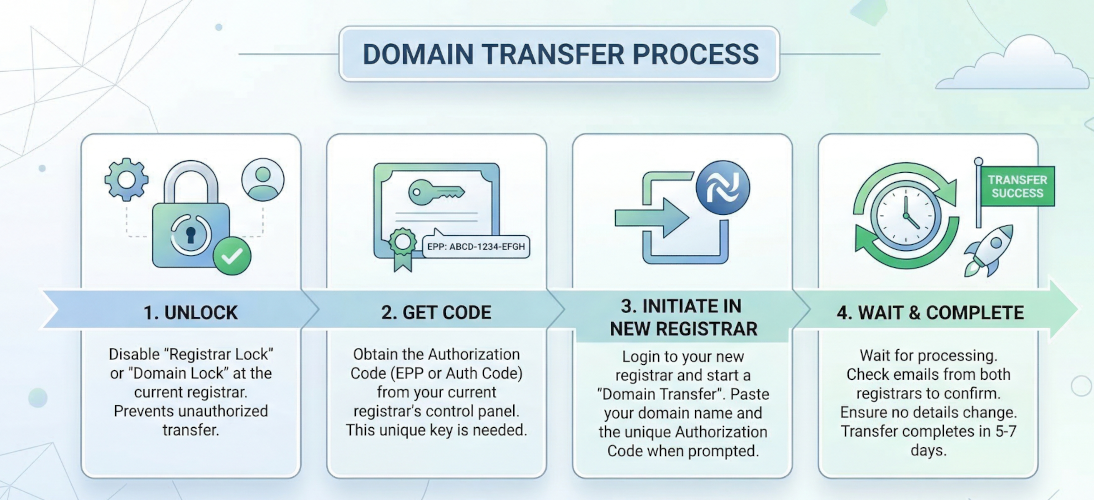
- Unlock domain
- Share secret code (retrieved from loosing registrar) to welcoming registrar
- Wait (up to 7 days)
(in general)
Risky operation… 🥵
How to protect a domain
- Solid registrar (B2B, certifications, no past record of being hijacked…)
- Registry lock
- Secure access to registar (IP restrictions, 2FA, etc…)
- Scarce access to registrar and owner email (secret transfer code…)
- Keep whois email up to date
- Ensure auto-renewal of domains (but a serious registrar will imply it)
- Monitor payment failures and card expiration (or better: use wire transfer if B2B registrar)
What possible registrar portfolio distribution?
Small size company
Not really a concern, any approach can make it
Mid size company
- A B2B registar like MarkMonitor, ComLaude, CSC Global or NameShield for critical domains
- Cloudflare for non critical domains and low prices (retail prices, unbeattable)
- GoDaddy or Gandi (registrar is their business) for more TLD-compatibility and still low prices
- Another B2B registrar like SafeBrands or LexSynergy for exotic (not critical) domains
Clean, optimized for lowering risks, maintenance and bill
(you can pay me a beer for this)
Big company
Same than mid size (with bigger team on company side) or think about going for single registrar approach (but expensive!).
Realize the effort
- Hundreds of domains will renew all along the year (week end, vacations, Christmas, New Year’s Eve, etc…)
- They will produce thousands of emails each year, and you have to review them carefully!
- Registrant details updates
- Almost each TLD (in particular ccTLDs) has its own rules for registration and renewal
Looks a job for automation and AI! But whois limitations (e.g. try to whois for example.mt) and risks associated with API makes it difficult to fully automate.
There are so many registrars
Ionos, OVH, GoDaddy, NameCheap, Cloudflare, EuroDNS, Nic.ae, MyNIC, Gandi, UnstoppableDomains, OnlyDomains, NIC-MT, WhoGoHost, EuropeRegistry, Enom, ExaBytes, EnCirca, NIC.cy, IPServerOne, Marcaria, MyNIC, Afternic, BulkRegister, OpenSRS, Dominder, BlueHost, AsiaRegister, Hover, BlackNight, JapanDomains, SafeBrands, AfriRegister, TuCows...
Your early ccTLDs purchases would likely fall into the trap of local registrars…
Strategic coverage and defensive registrations
Starting from mid size company, you need to work on strategic coverage and defensive registration.
Following options are good to explore:
- ccTLDs of countries where you have an office
- ccTLDs of countries considered possible markets
- ccTLDs almost considered gTLDs
- nTLDs sounding relevant to our business
- gTLDs with common typos
- gTLDs homonyms/homoglyphs
- gTLDs brand + relevant keyword combinations
- Block lists (check list if valuable for you?)
- Dispute scammers domains (WIPO + UDRP, URS, TMCH)
Even if domains are not really expensive by design, you still need to balance with budget
Deciding when to stop is a typical job of domain portfolio manager
Why balancing?
Sure you want to strenghten the brand.
But you could spend all your money and it would still remain partial coverage.
Because defensive registration is a “lost battle” 😔
(I estimate buying all available TLDs for a name to cost between $100K and $200K per year)
The importance of registrant email
- Zero compromise on registrant email, of the utmost importance!
- Zero compromise on registrant email, of the utmost importance!
- Zero compromise on registrant email, of the utmost importance!
- Zero compromise on registrant email, of the utmost importance!
- …
Owning the email = owning the domain, don’t mess with it
The importance of registrant details
- Local presence (registry requirement)
OV/EV SSL certificate issuance(no longer true since 2025)- Audits (regulator can request screenshot)
- ICANN policy (“must to be up to date”)
- Disputes (against company)
So we want registrant details to be up to date all the time, right? 🤓
Yes, in theory
But also consider that:
- Once issued, certificate authorities don’t monitor registrant (no revocation)
- Once audited, regulator don’t monitor registrant
- ICANN don’t enforce policy (beyond registrant email)
- Change has costs (fee + think registry lock)
- Also Change = Risk 😬 (triggers verifications: “COR”, “RAA”, etc…)
And you don’t want to awake the dragons!
Still better to update registrant details
- With extra care
- Also remember that change generally locks the domain for 60 days
DNS != Domain
- You generally want a DNS service independent from registrar
- Not the main purpose but it helps with transfers
But registrar “pilots” DNS
- Set NameServers via registrar
- Glue records (conceptual example: nameserver.example.com)
- DNSSEC:
- Set DS record via registrar
- Not all registrars are compatible (beware when transferring!)
“ConsoliDate”
- Align domains renewal date, when registry and registrar implement that
Conclusion
I hope you enjoyed this tour in the shoes of a domain portfolio manager.
This is an extremly vital role in a company, dealing with risks and vital assets.